Glad Påsk! Happy Easter!
Easter dinner at Mathias Dahlgren’s Matbaren/food bar was a defining experience for me and my family.
In that….
1. I believe a society can be defined by the kind food it eats.
2. I believe the way the food is prepared is a measure of that society’s respect for the food they eat.
3. I believe the way food is presented and the environment in which it is eaten is testament of that society’s attitude towards its people.
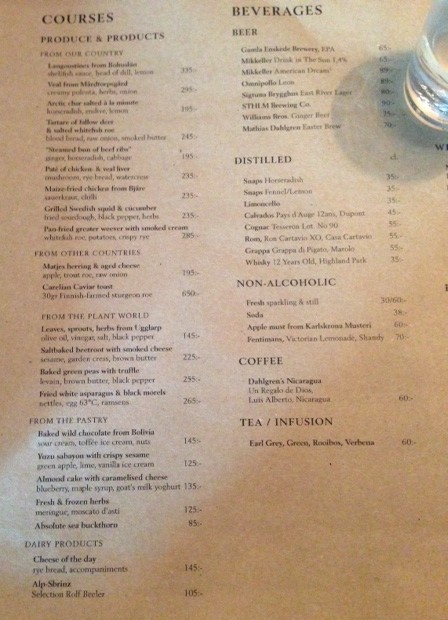
Here is what we ordered:
- Arctic Char salted à la minute – aka sushi
- “Steamed bun of beef ribs” – a deconstructed Hum Bow
- Maize fried chicken – chicken fingers with an armor like coating of corn flakes
- Saltbaked beetroot with smoked cheese – boiled beets with Parmesan sprinkled on top
- Fried white asparagus & black morels – asparagus pieces, green stuff & a soft cooked egg
- Baked wild chocolate from Bolivia – lava cake with ice cream and sour cream
- Almond cake with carmelized cheese
So how was Mathias Dahlgren’s? Allow me please to extrapolate my dining experience to Swedish society as a whole.
1. Mathias Dahlgren gets full marks for excellent ingredients that were mostly local and high quality. High notes were morels, white asparagus and beets. The proteins like lamb, arctic char and chicken might have been good but personally I think their treatment was their downfall. In Stockholm general local food quality is good but better is usually found among imported food stuffs due to climatic conditions and shorter growing seasons.
2. Preparation of these ingredients fell at either end the spectrum of “overly-prepared” to “under-prepared”. All the proteins we ordered seemed to be disguised, their recognizability masked by, for example, the thinness of the lamb chops or cornflake armor of the chicken fingers or rolled and endive-entwined arctic char. Then we had the opposite end of the spectrum, the rough chop of the white asparagus or the chunky beet pieces or the somehow displaced cucumber slices in the de-constructed hum bow/ “steamed buns with beef”.
The preparation in particular seemed the epitomy of “lagom”. That is Swedish for the national attitude of “enough is as good as a feast”. Well…no. No, it isn’t. Not in this case. Don’t mistake me, the portions of each of the à la carte items on the Matbaren menu were generous. But it was the way they were prepared. Not enough attention was given to blending and marrying flavors. The chef seemed to be relying quite a bit on the diner’s ability to grind the ingredients together in their mouths to arrive at the flavor the chef intended. Is that acceptable? I may yet still be unaccustomed to this “do it yourself” attitude from Swedish society while dining, but no. I don’t think that’s acceptable when you are paying a quarter of your month’s rent to take the family out to dinner.
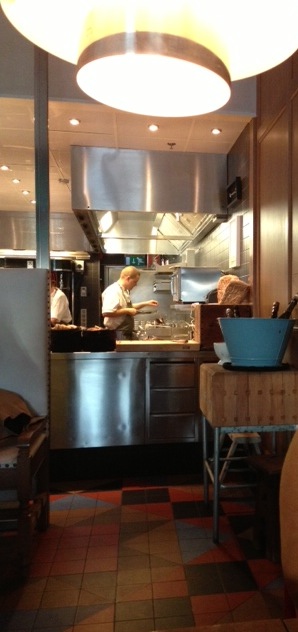
3. Presentation. Well…we are in Stockholm sooooo…cushy comfortable chairs are out. Cocooned booths where you don’t rub elbows with other diners is out. Attentive and obliging waitstaff is also out. What you are left with is… hard wooden benches randomly covered with skinned animals. Sharp, sharp knives at every setting (even for children). And tiny, tiny water glasses with a carafe of water you pour yourself.
None of this is a problem when it is simple fare. We have grown accustomed to fending for ourselves while dining out in Sweden (fetching implements, water, napkins, flagging down menus, the bill). But this is one of the most prestigious, expensive and snooty dining experiences to be had in Sweden.
So how about a little more obliging service toward the diners? No? My five year old who was beautifully behaved during our dining experience grew restless over the long delays between courses, the uncomfortable seats and the crowded conditions. She enjoyed the chicken fingers we ordered once I whittled them down to bite size and removed the armor like coating. But other than steering us away from an inappropriate dessert of Yuzu Zabaglione (they consented to two plain scoops of ice cream for her instead) there was a complete lack of interest to adjust to her comfort level. How about a cushion for her chair so she can see over the table? How about not looking at her like an alien when she politely asked for a glass of milk? Or when she reminded you to take away the extra wineglass at her place setting?
We had at least four different servers presenting the dishes at various times so it would be incredibly difficult to pin this dining experience on one bad waiter or waitress. No. There was no mistake. This was the experience they intended their diners to have.
I think the defining moment for me is when I ordered dessert. It’s just my favorite part of every meal because I figure I paid my dues working through the main courses so… how about something memorable and fantastic to leave me with a really good impression of the establishment? No? Not possible? You see all I wanted was to change the flavor of ice cream on my dessert plate of Chocolate Lave Cake from Toffee to Vanilla. Absolutely not, I was told. IT was forbidden. It must be served as written. But, you see, I tasted the untouched bitter Toffee ice cream on my daughter’s plate and much preferred the vanilla, as did she. I understand if you are ordering a tasting menu where everything is specifically set and pre-prepared that there are no substitutions. But this is 100% à la carte dining. There is no tasting menu at Matbaren.
It was just the snootiest of snoots. A moment that will forever indelibly etch itself in my mind about the inflexibility to accomodate a very, very simple request. Move 2 inches to the right to scoop up vanilla ice cream instead of toffee. You won’t be fired. I won’t tell. Apparently I would become the harbinger of Ragnarök if I challenged the slightest thing on the menu. And then there was the sour cream…
As my dessert plate was set down by yet another different waiter, I was told I MUST take a spoonful of sour cream on the plate with each bite of cake. It was so vile a pairing that I couldn’t help wondering if the chef was trying to insult me personally from the depths of his kitchen since I had asked for vanilla ice cream. I ate the cake in silence but with every bite I called into question the chef’s flavor palate. Why exactly does a strong wild chocolate from Bolivia needs a bitter, bitter Toffee ice cream as a companion? And the vile sour cream? Who thought that was a good idea?
Ragnarök, bring it on. Or rather let me mix metaphors and allow me to nail my thesis of fine dining to gates of Valhalla.
“Dear Vikings,
Please be nicer to your diners. If you put nails covered with chocolate sauce on your
menu don’t be surprised if they ask for a substitution for the nails.
Thanks!”
Overall the meal here was better than most fine dining cuisine in Stockholm but I feel it deserved a posting in my blog because it is so definitively Swedish an experience not to mention expensive. Mathias Dalhgren does not post menus. You deserve to know what you are in for.